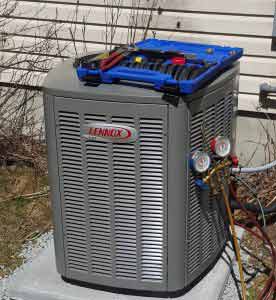
Deciding whether to repair or replace your old air conditioner comes down to its age, the cost of the repair, and the type of refrigerant it uses. Age, refrigerant type and repair cost are reasons to compare options, not automatic replacement instructions. Ask for a diagnosis, confirmed warranty coverage and an itemized replacement quote; a fixed repair-cost percentage alone does not determine the better choice. With new, highly affordable side-discharge AC units and cold-climate heat pumps dominating the Ottawa market in 2026, upgrading your equipment is often more cost-effective long-term than continually patching a failing system.
It happens every summer in Ottawa. Right in the middle of a sweltering July heatwave, your air conditioner suddenly stops blowing cold air. As your house gets hotter and stickier, you start frantically searching for an AC repair near me. But once the technician diagnoses the problem and hands you an estimate, you are faced with a much tougher question: Is this repair actually worth the money, or is it time to replace the whole system?
At AirZone HVAC Services, we believe in honest, no-pressure recommendations. We have seen homeowners waste thousands of dollars replacing parts on a dying unit, and we have also seen people pressured into buying a new AC when a simple $150 part could have solved the issue.
If you are on the fence about your current cooling system, here is our expert guide on how to decide whether to repair or replace your old air conditioner in 2026.
1. What the $5,000 rule can—and cannot—tell you
The $5,000 rule multiplies the unit’s age in years by a proposed repair cost. It is a rough comparison score, not a replacement price or a diagnosis. A result above 5,000 can prompt a closer comparison with replacement, but it does not automatically make the repair a poor choice.
For example, a hypothetical 12-year-old air conditioner with a CAD $600 repair quote gives a score of 7,200. That calculation alone cannot establish its condition, the repair’s value, actual warranty coverage or the cost of an appropriate replacement. The familiar cutoff is not a validated Canadian-dollar standard.
2. The Age of the System (and the Refrigerant Trap)
The average lifespan of a standard central air conditioner in Ottawa is between 10 and 15 years. If your unit is pushing past the decade mark, components will naturally begin to fail.
Refrigerant type also matters. Canada phased out the import and manufacture of R-22 for use as a refrigerant in 2020. That phaseout alone does not establish whether a particular repair is feasible or worthwhile. If an older system has a refrigerant leak, ask a qualified contractor to identify the fault and explain compliant repair options, refrigerant availability, the full repair cost and the replacement alternative. Do not assume that refrigerant can simply be topped up or that replacement is the only option.
3. Frequency of Breakdowns and Comfort Issues
Are you searching for an AC service company near you every single summer? If your air conditioner requires constant “band-aid” fixes, those service call fees and minor part replacements add up fast.
Furthermore, consider your actual comfort. An older, failing air conditioner loses its ability to dehumidify your home effectively. If your system runs constantly but your upstairs bedrooms are still hot and sticky, repairing the old unit won’t magically give it new cooling power. A modern replacement will provide vastly superior airflow, targeted cooling, and humidity control.
Repair vs. Replace: The Quick Comparison
| Decision Factor | When to Repair | When to Replace |
|---|---|---|
| Age of Equipment | Under 10 years old | Over 12-15 years old |
| Cost of Repair Quote | A diagnosed repair with a clear scope and confirmed out-of-pocket cost | Compare an itemized installed quote; no fixed percentage decides the outcome |
| Refrigerant Type | Ask whether a compliant repair and suitable refrigerant are available | R-22 requires a specific repair-feasibility and cost assessment |
| Repair History | This is a rare, one-off breakdown | Multiple service calls in the last 2-3 years |
| Energy Bills | Normal summer utility costs | Bills are inexplicably spiking every summer |
The 2026 Replacement Options: Why Upgrading Makes Sense Now
If the math points toward a replacement, Ottawa homeowners are actually in a fantastic position this year. The 2026 HVAC market features cutting-edge technology that is significantly more affordable than you might think. You do not have to settle for another loud, bulky metal box in your backyard.
If you are booking an air conditioning installation in Ottawa, you have two incredible, high-value options:
- The Moovair Maelys AC: If you are on a budget, this new slim, side-discharge air conditioner is completely disrupting the market. Starting around $3,000 (and averaging $4,000–$5,000 fully installed), you get ultra-quiet, variable-speed inverter technology for the exact same price as a loud, outdated builder-grade model. You can learn more about it on our Moovair Maelys product page.
- Cold-Climate Heat Pumps: If you want to slash your winter natural gas bills, upgrading to a heat pump is the smartest long-term play. It acts as an incredible air conditioner in the summer, and reverses to provide highly efficient heating in the winter, heavily reducing your reliance on fossil fuels.
Get an Honest Diagnostic from AirZone
Whether you live in Kanata, Barrhaven, Orleans, or downtown Ottawa, having an honest contractor inspect your system is the most important step in this process.
Our directly employed technicians do not work on high-pressure commissions. If your AC just needs a minor repair to get you through another three summers safely, we will tell you. If the unit is a money pit, we will outline your most affordable, high-efficiency replacement options.
Need a professional set of eyes on your system? Contact us today to book an AC repair and diagnostic or request a free, no-obligation quote on a modern cooling upgrade!