If you have noticed more static shocks than usual this week, or if your family is waking up with scratchy throats and dry skin, you aren’t alone.
Lately, our phones at AirZone have been ringing off the hook—not just for furnaces, but for Indoor Air Quality (IAQ). Ottawa homeowners are realizing that a warm house isn’t necessarily a comfortable one.
The two biggest culprits? Dryness (low humidity) and Staleness (lack of fresh air).
While rebates have dominated the headlines for the last year, the real secret to a comfortable home in 2026 lies in two often-overlooked boxes in your basement: your Humidifier and your HRV/ERV.
Here is our master guide on how these systems work, which products we recommend, and how to maintain them yourself.
Part 1: The Humidity Problem (And How to Fix It)
In the dead of an Ottawa winter, outdoor air is incredibly dry. When your furnace heats that air up to 21°C, the relative humidity can drop below 15%—drier than the Sahara Desert.
The Consequences:
- Health: Dry air dries out your mucous membranes, making you more susceptible to flu viruses.
- Home: Hardwood floors crack, gaps appear in molding, and expensive musical instruments can warp.
- Comfort: Dry air feels colder. You might be cranking the heat to 23°C just to feel warm.
The Solution: Whole-Home Humidifiers
Forget the portable units that you have to refill daily. We recommend systems that integrate directly into your ductwork.
Our Top 2026 Picks:
- The “Workhorse” (Bypass): The GeneralAire 1042 has been our best-seller for nearly 20 years for a reason. It’s rock-solid, affordable, and uses a simple bypass method to wick moisture into your air.
- The “Performer” (Fan-Powered): The Aprilaire 700 doesn’t rely on your furnace’s airflow alone. It has its own fan to push humidity into the ducts, making it perfect for larger homes.
- The “Gold Standard” (Steam): The Aprilaire 800 boils water into steam and injects it into your airflow. If you have expensive hardwood or large square footage, this provides the most precise control regardless of air temperature.
- Pro Tip: Aim for 35% – 50% humidity. Anything lower is too dry; anything higher risks condensation on your windows.
Part 2: The Fresh Air Problem (HRV vs. ERV)
Modern homes in Kanata and Barrhaven are built “tight” to save energy. The downside? They trap stale air, cooking odors, and CO2 inside.
The Solution: Heat Recovery Ventilators (HRV)
An HRV is the “lungs” of your home. It pushes stale indoor air outside and pulls fresh outdoor air inside. Crucially, it captures the heat from the outgoing air and transfers it to the incoming air, so you don’t freeze your furnace.
HRV vs. ERV: What’s the Difference?
- HRV (Heat Recovery Ventilator): Best for winter moisture control. If your windows have condensation (ice) on them in January, an HRV is the superior choice because it exchanges dry outdoor air with moist indoor air.
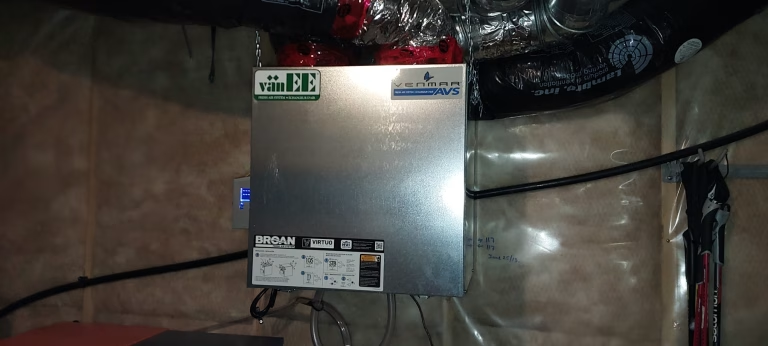
- Our Top Pick: The Vanee AI Virtuo. It is one of the most intelligent units on the market, using self-balancing AI to ensure perfect airflow without constant tweaking.
- ERV (Energy Recovery Ventilator): Best for summer humidity control. It transfers both heat and moisture. If you want to run your ventilation year-round (even in humid July), an ERV keeps the humidity outside where it belongs.
- Our Top Pick: The Panasonic Intellibalance 200. Rated as “Ultra Green,” this unit is incredibly efficient at retaining your home’s energy while providing fresh, filtered air.
Part 3: DIY Maintenance (Save Money & Service Calls)
You don’t always need to call us to keep these systems running. Here is a quick 7-step tune-up you can do this weekend.
The 15-Minute HRV Tune-Up
- Power Down: Unplug your HRV unit.
- Filter Check: Slide out the core filters. These should be cleaned or replaced every two months. A blocked filter can kill the motor!
- Check the Hoods: Go outside and check the intake/exhaust vents on the side of your house. Clear away any snow, ice, or leaves blocking airflow.
- Clear the Drain: Ensure the condensate drain tube (the clear plastic hose) isn’t kinked or blocked.
- Clean the Core: Remove the main heat exchange core and vacuum or rinse it according to your manual (usually once a year).
- Inspect Grilles: Check the fresh air supply vents inside your home (usually high on the wall) to ensure they aren’t painted shut or blocked by dust.
- Power Up: Plug it back in and listen for smooth fan operation.
The “Garbage Bag Test” (Is Your System Balanced?)
If you suspect your HRV isn’t working right, try this trick:
- Tape a large garbage bag over the outside exhaust vent.
- Turn the unit on. Time how long it takes to inflate.
- Repeat on the intake vent (measure deflation).
- The Goal: If the times are roughly equal, your system is balanced. If one is way faster, your system is fighting negative pressure and needs professional balancing.
Breathe Easier This Winter
You spend 90% of your winter indoors. The quality of that air defines your health and comfort.
Whether you need a new Aprilaire humidifier to save your skin or a Vanee HRV to banish stale odors, AirZone has the stock and the expertise to help.
Ready to upgrade your air? Get a Free Ventilation or Humidifier Quote