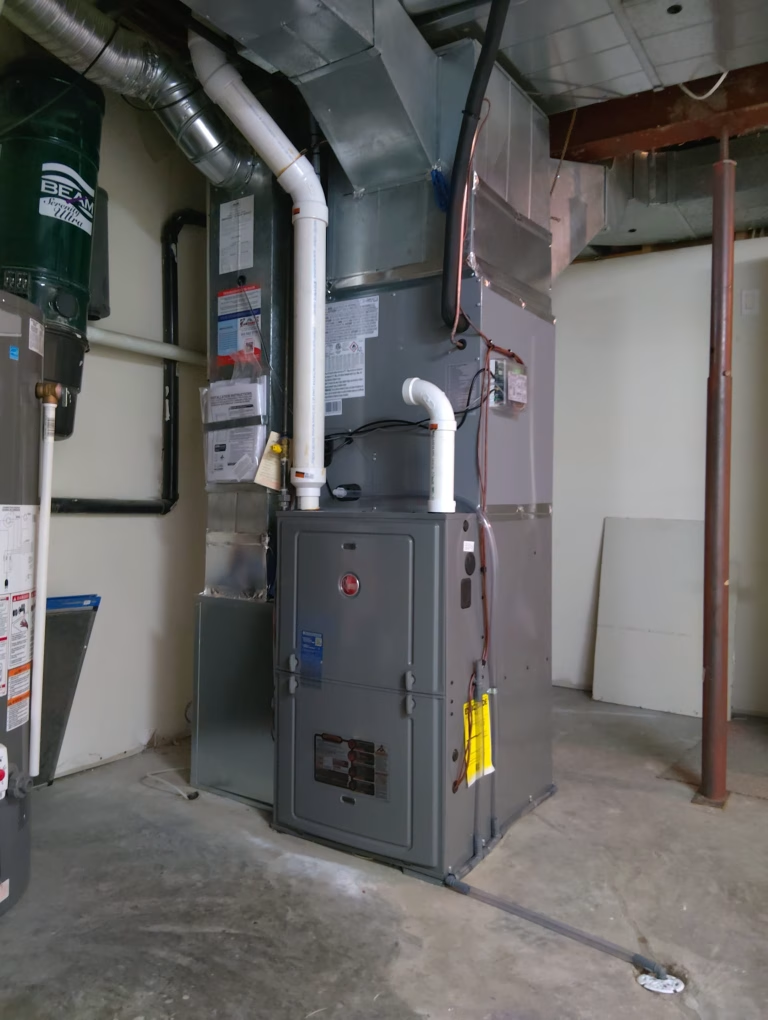
So, you have made the tough decision. You read our breakdown on Repair vs. Replace, you did the math, and you realized that sinking another $1,200 into your aging furnace just doesn’t make sense.
You are ready to buy a new system. But then you started Googling, and things got complicated.
- “Should I get a heat pump or a furnace?”
- “What is a Hybrid system?”
- “Why do quotes range from $5,000 to $18,000?”
In 2026, buying a heating system is no longer just about swapping one metal box for another. It is about choosing a fuel strategy for the next 15 years. With carbon taxes rising and technology evolving, the “standard” choice isn’t always the smart choice anymore.
This resource is your roadmap. We will strip away the jargon, explain the real-world costs for Ottawa homeowners, and help you decide whether you should stick with gas, go electric, or choose the “best of both worlds” hybrid approach.
Part 1: The Three Paths (Which One Are You?)
In the past, you only had one option: a gas furnace. Today, Ottawa homeowners generally fall into one of three categories.
Path 1: The Traditionalist (High-Efficiency Gas Furnace)
You want reliability, you want to stick to a lower upfront budget, and you are comfortable with natural gas.
- The Tech: A 96% to 99% AFUE Gas Furnace.
- The Cost (2026 Est): $5,000 – $7,500 installed.
- Pros: Lowest upfront cost; proven reliability in -30°C weather; excellent for homes with existing ductwork.
- Cons: You are 100% exposed to rising carbon taxes and gas rates; no cooling included (you still need a separate AC).
- Best For: Homeowners on a strict budget or those planning to move in the next 3–5 years.
- Our Pick: The Rheem Classic Plus or Lennox EL296V.
Path 2: The “Future-Proofer” (All-Electric Cold Climate Heat Pump)
You want to get off fossil fuels entirely, perhaps to lower your carbon footprint or because you have solar panels.
- The Tech: A “Cold Climate” Air Source Heat Pump (ccASHP) with an electric air handler backup.
- The Cost (2026 Est): $12,000 – $16,000 installed.
- Pros: Zero gas bill; huge greenhouse gas reductions; ultra-efficient cooling in summer.
- Cons: Higher upfront cost; electricity can be expensive during peak “Time of Use” hours; recovery time (heating the house up) is slower than gas.
- Best For: Homes with solar panels, rural properties without gas lines, or eco-conscious homeowners.
- Our Pick: The Mitsubishi Zuba Central or Lennox SL25XPV.
Path 3: The “Ottawa Smart Choice” (Hybrid Dual-Fuel)
This is the fastest-growing trend in 2026. It combines a Heat Pump (for mild weather) with a Gas Furnace (for the deep freeze).
- The Tech: A Heat Pump outside + A Gas Furnace inside (controlled by a smart thermostat).
- The Cost (2026 Est): $11,000 – $15,000 installed (before rebates).
- Pros: Cheapest operating cost (uses cheap electricity for 80% of winter, cheap gas for the 20% deep freeze); excellent comfort; redundancy (two heat sources).
- Cons: Higher upfront cost than a furnace alone.
- Best For: The average Ottawa family wanting to minimize monthly bills while keeping “gas power” safety for -30°C nights.
Part 2: Sizing is Science (Why “Manual J” Matters)
The biggest mistake we see competitors make? Oversizing.
In the old days, if you had a 100,000 BTU furnace, a lazy contractor would just install a new 100,000 BTU unit. But your home has changed. You have better windows, more attic insulation, and maybe a finished basement.
If you put a massive furnace in a tight home, it will “short cycle”—turning on and off every 4 minutes. This kills the motor, wastes fuel, and leaves your upstairs hot while your basement stays cold.
The AirZone Standard: We perform a Manual J Load Calculation on every major install. We measure your windows, insulation, and square footage to determine exactly how much heat you need. In many cases, we find a home can be perfectly heated with a smaller, quieter, less expensive 60,000 or 80,000 BTU unit.
Learn more about our Installation Process
Part 3: The Neighborhood Factor
Ottawa isn’t one uniform city. Where you live dictates what system performs best.
If you live in Kanata or Stittsville:
- The Challenge: These areas often have larger, single-family homes with open fields nearby (high wind chill).
- The Solution: We often recommend Hybrid Systems here. The wind chill demands the raw power of gas during storms, but the large square footage makes the savings of a heat pump very attractive in March and November.
If you live in Barrhaven or Orleans:
- The Challenge: High density of townhomes and terrace homes. Your neighbors are close, so outdoor unit noiseis a massive factor.
- The Solution: Look for “inverter-driven” heat pumps like the Lennox SL25XPV. They run at a whisper-quiet decibel level (as low as 58 dB), ensuring you don’t get noise complaints from the neighbor sharing your fence.
If you live in Nepean (Older Subdivisions):
- The Challenge: Homes built in the 1960s-80s often have restrictive ductwork that wasn’t designed for modern airflow.
- The Solution: Variable-speed blower motors are non-negotiable here. They can adjust their pressure to overcome undersized ducts, finally fixing those “cold bedrooms” you have lived with for years.
Part 4: Brand Wars (Lennox vs. Rheem vs. Mitsubishi)
We are transparent about the brands we trust. We don’t carry “everything” because we prefer to be experts on the best.
- Rheem: The value king. If you want a reliable gas furnace or standard heat pump that offers incredible bang-for-your-buck, Rheem is hard to beat. Their “Classic Plus” line is a staple in Ottawa for a reason.
- Lennox: The luxury innovation leader. If you want the quietest system on the market, or the smartest thermostat (the S40), Lennox is the way to go. Their efficiency ratings are often the highest in the industry.
- Mitsubishi: The electrification expert. If you are looking for a Cold Climate Heat Pump (Zuba), Mitsubishi is the pioneer. They practically invented the category of heat pumps that work at -30°C.
Frequently Asked Questions (FAQ)
Q: How long does it take to install a new system? A: A standard gas furnace swap takes roughly 4 to 6 hours. A complex Hybrid or Heat Pump conversion typically takes 1 full day (8–10 hours) because we need to run new electrical lines and set up the outdoor unit.
Q: Will a heat pump really work in Ottawa when it is -30°C? A: Yes, but with a caveat. “Cold Climate” models (like Mitsubishi Zuba) can produce heat down to -30°C, but their efficiency drops as it gets colder. That is why we love Hybrid systems—they automatically switch to gas when the heat pump stops being efficient, giving you total safety.
Q: What is the warranty on a new system? A: Most premium units (Rheem/Lennox) come with a 10-Year Parts Warranty and a Lifetime Heat Exchanger Warranty. At AirZone, we also offer labor warranties to ensure you aren’t paying for service calls in the first few years.
Q: Do I need to upgrade my electrical panel for a heat pump? A: Sometimes. A heat pump requires a 220V dedicated circuit (similar to an electric stove). If you have an older 100-amp panel that is fully loaded, you might need a panel upgrade or a “load miser” device. Our quote includes a full electrical assessment.
Q: Are there still rebates in 2026? A: Yes! While the old Greener Homes Grant has evolved into the Home Renovation Savings (HRS) program, there are still thousands of dollars available for specific high-efficiency heat pump upgrades. We handle the equipment selection to ensure you qualify.
The Bottom Line
Buying a new heating system is a 15-year commitment. Do you want to lock yourself into 2040 with 1990s technology? Or do you want a system that lowers your bills, improves your comfort, and protects you from rising energy costs?
Let’s design the perfect system for your home. We offer free, no-pressure quotes across the entire Ottawa region.