
Air quality testing with a practical next step
Persistent odours, airborne dust or humidity concerns can leave you unsure what to change. At AirZone, we help Ottawa homeowners investigate indoor air quality and understand where ventilation, filtration or moisture control may help.
We start with what you notice and use monitoring to answer a specific question. Our Home Advice test gives us a record to review with you, so recommendations can reflect your home and the conditions measured.
Serving Ottawa homeowners since 2005. Local HVAC experience, air-quality reports and help choosing compatible equipment.
What’s included in the Home Advice test?
We bring the monitor to your home, collect readings over time and return to explain the results. Tell us about the affected rooms, recent changes and the times when the concern is most noticeable.
Arrange your test
Discuss the concern with our team and confirm the measurements, monitor placement, duration and price for your appointment.
Monitor your home
We drop off our Home Advice monitor for a minimum of three days. For many homes, we recommend a one-week rental to build a longer report.
Review the findings
We print your results at our office, return to pick up the monitor and go through the indoor air quality report with you.
Detailed Air Quality Analysis
$299.99 plus HST
Confirm the test scope and scheduling with our team when booking. Additional radon testing is a separate option; ask about its method, duration and price.
Request a Home Advice testSix measurements we use in our assessment
Our indoor air quality service covers the following measurements. A report describes the conditions captured during monitoring. It cannot detect every pollutant, diagnose a health condition or certify that a home’s air is safe.
Airborne particulates
Particle readings help us discuss airborne dust and other particles, possible sources and whether a filtration review would be useful. They do not identify every substance in the air.
Volatile organic compounds
VOC readings can help investigate changes associated with products or materials in the home. Ask what the monitor measures; a general VOC reading does not identify each individual chemical.
Carbon dioxide
CO₂ readings give us information to consider alongside occupancy and ventilation. They are one part of the assessment, rather than a complete measure of indoor air quality.
Relative humidity
Humidity readings help us discuss dampness, condensation and overly dry air. We consider the season and your home when reviewing the pattern.
Temperature
Temperature readings show how comfort conditions change during the monitoring period and help put humidity readings into context.
Carbon monoxide
CO is included among our testing parameters. Routine monitoring does not replace a working carbon monoxide alarm or emergency response.
For background on appropriate monitoring and its limits, see Health Canada’s indoor air quality guidance.
If your carbon monoxide alarm sounds
Leave the building immediately and move to fresh air. Call 9-1-1 from outside. Do not go back inside to find the source or wait for an air quality appointment.
Choose a response that fits the concern
Testing and equipment selection are separate decisions. We can help you consider pollutant sources, ventilation and your existing HVAC system before choosing a product. Our role is to explain the options and their practical requirements.
Filtration and air purification
We offer furnace filter cabinets, HEPA bypass filtration and other air-purification options, including UV equipment. Suitability depends on the concern and the system. We also help you find replacement filters.
Ventilation and humidity control
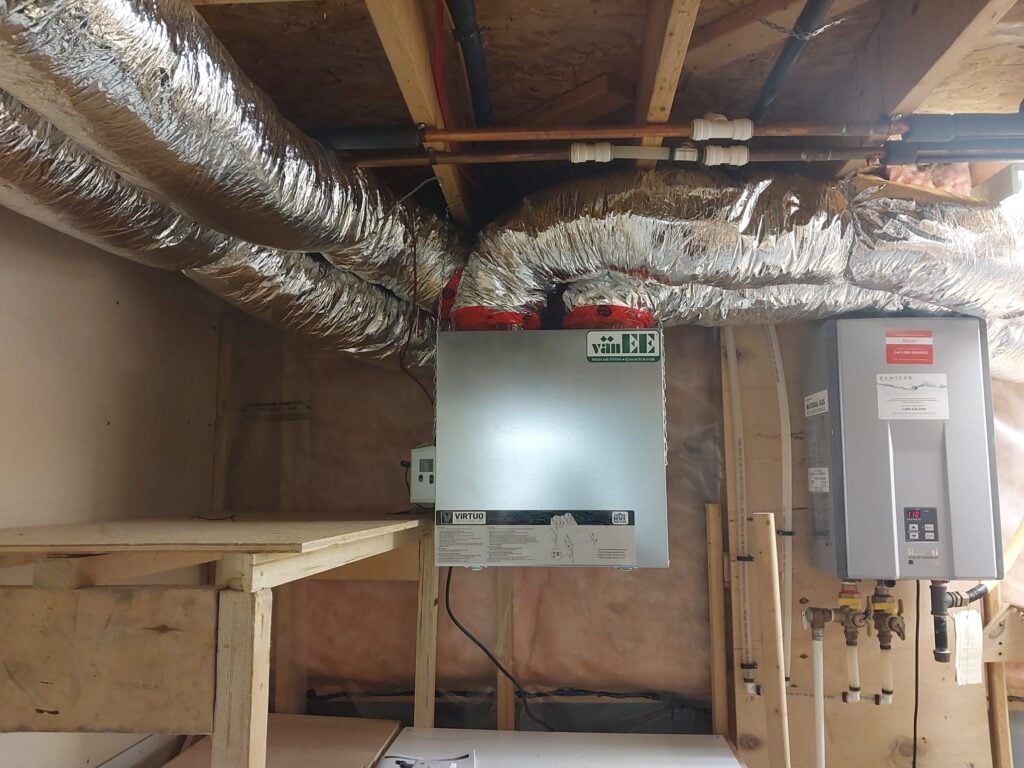
We can discuss HRV and ERV ventilation, humidifiers and other moisture-control options. We consider your home’s layout and equipment, including homes without existing ductwork.
Health Canada recommends addressing indoor pollution sources and improving ventilation. See its home air quality advice.
Commercial indoor air quality testing
We also provide commercial IAQ testing and can discuss suitable ventilation, filtration and other corrective equipment. Because building types and concerns vary, we provide a custom commercial testing quote free of charge.
Tell us about the property, how the space is used and the concern you want to investigate so we can discuss an appropriate scope.
Air quality testing questions
How do I know whether to book an air quality assessment?
Persistent odours, visible airborne dust, condensation or rooms that feel stuffy are useful reasons to discuss your home with us. Tell us where and when the problem occurs and what has changed. These observations do not identify a particular pollutant. An assessment can help decide whether monitoring will answer your question.
How long does the Home Advice test take?
We leave the Home Advice monitor in your home for at least three days. A one-week rental is recommended for many homes so we can review a longer record. The right duration depends on the concern and what is being measured; confirm the schedule when you book.
What does residential air quality testing cost?
Our Detailed Air Quality Analysis is $299.99 plus HST. The Home Advice service includes monitor drop-off, the monitoring period, pickup and a discussion of your report. Ask us to confirm the scope and any additional testing charges before booking. Commercial properties receive a custom quote.
Do you test for mould?
No. We do not offer mould testing or mould remediation. Humidity readings may help with a discussion about dampness or condensation, but they do not identify mould or replace a specialist assessment.
Is radon included in the Home Advice test?
Radon testing is offered as an additional test. Ask us about the method, duration and separate price before booking. Do not assume the Home Advice monitoring period or its six listed measurements includes a radon assessment.
Can you help if my home has no ductwork?
Yes. We can discuss suitable portable air-quality equipment and ventilation options for homes heated by boilers, ductless heat pumps or electric baseboards. The recommendation depends on the issue, the layout and what can be installed in your home.
Will a better furnace filter solve the problem?
A suitable filter can help capture airborne particles, but it does not address every air-quality concern. We can review filter fit, the needs of your heating and cooling system and replacement requirements. Ventilation, moisture control or reducing a pollutant source may also need attention.
Tell us what you’re noticing
Let us know which rooms are affected, when the issue began and whether there have been renovations, water problems or changes to your heating and cooling equipment. We’ll help you understand the next step.